
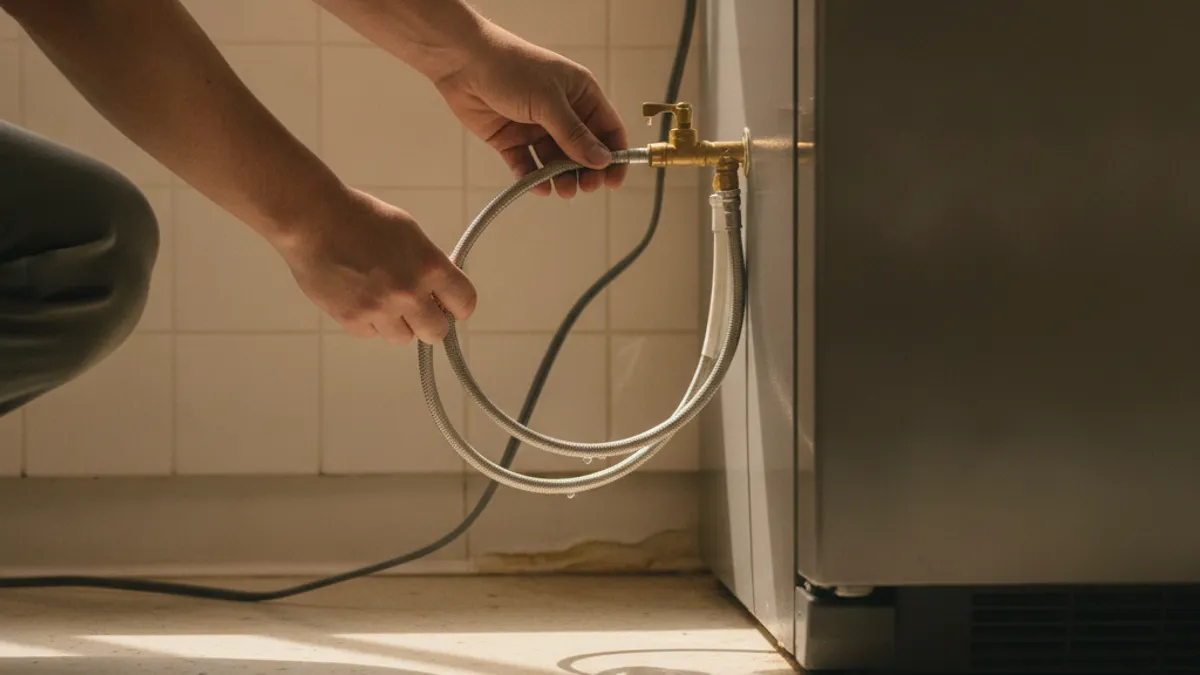
Refrigerator water line leaks: plumbing or appliance
A leak behind the fridge isn't always the appliance. Here's how San Diego homeowners can tell a plumbing supply line problem from an internal ice maker failure.
The short answer
- A puddle tracing back to the wall, shutoff valve, or supply tubing is a plumbing problem. Water pooling inside the fridge or dripping from the unit itself is appliance-internal.
- Saddle valves, the self-piercing type often used for quick ice maker hookups, are a common source of slow leaks and should be replaced with a proper ball valve.
- San Diego's hard water scales up the narrow quarter-inch supply tubing and the fridge's internal filter and fill valve over time, a real contributor to reduced ice output.
- Braided stainless steel supply lines have replaced plastic poly tubing as the standard, since poly becomes brittle and cracks after repeated fridge moves.
- A slow leak behind an appliance is a common source of hidden water damage precisely because it goes unnoticed. A cheap valve fix now beats a flooring repair later.
A puddle behind the refrigerator sends most homeowners straight to the appliance manual, but the source of the leak isn’t always the fridge itself. Sometimes it’s the plumbing feeding it, a supply line, a valve, or a fitting that’s been quietly failing behind an appliance nobody moves often enough to notice.
Telling plumbing from appliance in about two minutes
Pull the fridge out from the wall, which is easier than most people expect since most units have wheels or slide feet. Look at where the water actually is. If the puddle traces back toward the wall, a shutoff valve, or the thin tubing running from the wall to the back of the appliance, that’s a plumbing issue, a fitting, valve, or line has failed somewhere in that run. If the floor behind the fridge is dry but you’re finding water pooling inside the freezer, dripping from underneath the unit itself, or an ice maker that’s stopped producing ice and started leaking instead, that’s almost always internal to the appliance, the fill valve or the ice maker assembly, and it needs an appliance technician, not a plumber.
The saddle valve problem
A lot of ice maker leaks trace back to a saddle valve, a self-piercing valve clamped onto an existing copper or PEX line that punctures the pipe to create a water tap without needing to cut and solder a proper fitting. They’re a fast install, which is exactly why they show up so often in older San Diego homes where an ice maker was added after the original build. The problem is the piercing itself. It narrows the water path at exactly the spot most prone to mineral buildup and corrosion, and San Diego’s hard water, running about 16 grains per gallon depending on your district, accelerates that scaling. Over years, saddle valves develop slow leaks around the piercing point, sometimes for months before anyone notices water pooling behind an appliance that rarely gets pulled out.
The fix is a proper tee fitting with a dedicated quarter-turn ball valve, either soldered onto copper or push-fit connected on PEX, replacing the saddle valve entirely rather than trying to tighten or reseal it.
What hard water does to the line over time
The quarter-inch tubing feeding a refrigerator’s water dispenser and ice maker is narrow enough that scale buildup has an outsized effect. San Diego’s hard water deposits calcium and magnesium inside that tubing and inside the fridge’s internal water filter and fill valve over time. This shows up first as reduced ice production and slower dispenser flow, then eventually as valve failure, either inside the fridge or at the shutoff behind it. If your ice maker has been making less ice than it used to, and the filter’s been changed recently, hard water scale further up the line is worth checking before assuming the appliance itself is failing.
The water filter housing, a spot that’s easy to overlook
Most refrigerators built in the last fifteen years have an internal water filter cartridge, usually located behind the bottom grille or inside the upper cabinet, and the housing around it is a common leak point that has nothing to do with the supply line itself. An improperly seated filter, a cracked housing from over-tightening, or an old O-ring that’s lost its seal can all cause a slow drip that looks identical to a supply-line leak from a few feet away. Before assuming the problem is upstream at the wall or the shutoff valve, pull the filter, check the O-ring for cracking or flattening, and reseat it fully. This is a five-minute check that rules out one of the more common sources of a “mystery” leak behind an otherwise properly connected fridge.
Plastic, copper, or braided stainless
Older installs commonly used plastic poly tubing, which is inexpensive and easy to route but becomes brittle after several years, especially once it’s been kinked repeatedly from pulling the fridge out for cleaning. A cracked poly line is one of the most common sources of a slow, hard-to-spot leak. Copper is durable but harder to route around a tight kitchen cabinet run and more work to repair if it does fail. Braided stainless steel supply lines have become the standard for a reason: they resist kinking, handle repeated fridge moves without degrading, and connect cleanly to a proper ball valve. If your fridge is still running on the original plastic line from installation, swapping it for braided stainless is a low-cost way to head off a future leak, similar to the outdoor faucet leak fixes we cover elsewhere, where an inexpensive fitting swap prevents a much bigger repair down the line.
Why a slow leak behind an appliance matters more than it looks
A drip that’s barely visible on the surface is still a leak running continuously, and it’s one of the more common sources of hidden water damage precisely because nobody’s looking back there regularly. Flooring, subfloor, and cabinetry near a refrigerator can absorb months of slow leakage before it becomes visible from the front of the kitchen. We’ve written more broadly about signs of a hidden water leak in San Diego homes, and a refrigerator supply line is one of the most overlooked spots on that list, mostly because moving a full fridge to check behind it isn’t something most people do on a regular basis.
Catching it early is a small job. A shutoff valve or a length of supply line runs a modest repair cost, usually well under $200 including the appliance move and reconnection. Left alone for months, the same slow leak can turn into a flooring or subfloor repair running into the thousands.
What to do if you find a leak
Shut off the dedicated valve behind the fridge if there is one, or the main water shutoff if you can’t isolate it separately, our guide on finding your main shutoff valve walks through that if you’re not sure where it is. Then check whether the leak is coming from the line and valve (plumbing) or from inside the appliance (icemaker or fill valve). If it’s the line, a plumber can replace the valve and tubing in one visit, usually swapping any saddle valve for a proper connection at the same time.
When you’re ready
If you’ve found water behind your fridge and aren’t sure whether it’s the plumbing or the appliance, call us at (858) 400-4417. The plumber we connect you with will check the shutoff valve, the supply line, and the connection point, and give you a straight answer on whether it’s a plumbing fix or something to hand off to an appliance technician.
Areas this guide covers
We connect homeowners with licensed plumbers in these San Diego County communities.
Keep reading
Need a Plumber in San Diego?
Licensed, insured plumbers, ready across San Diego County. The plumber quotes you before any work starts.
Call (858) 400-4417Call any time, day or night, anywhere in San Diego County