
Last updated: September 18, 2026
Multiple drains backing up at once in San Diego
Toilet, shower, and floor drain backing up together is a main-line plumbing drain clog. Stop all water use, skip chemicals, and call a San Diego plumber.
The short answer
- Several fixtures backing up at once is a main-line plumbing drain clog, not a single toilet or shower jam.
- Stop all water use. Do not add chemical drain cleaner. Look for the outdoor sewer cleanout if you can find it, then call.
- One clogged toilet is a local problem. A toilet, shower, and floor drain together is the shared line.
- In the City of San Diego, you maintain the sewer lateral to the connection with the main, which may sit past the property line.
- We connect you with licensed plumbers for drain cleaning, sewer work, and hydro jetting. Call (858) 400-4417.
When a toilet, shower, and floor drain back up at the same time, that is a main-line plumbing drain clog, not a single-fixture jam. Stop using every drain in the house. Do not pour chemicals. Look for the outdoor sewer cleanout if you can find it, then call a plumber.
Why several drains backing up at once is a main line clog
One slow sink is usually that fixture’s trap or branch. Several openings rising together means the restriction is on the shared path those fixtures use to leave the house.
Count the fixtures, not the mess. A toilet that will not flush, a shower that stands with dirty water, and a floor drain that gurgles or overflows are three symptoms of one line. Run a faucet in another bathroom and watch the first one. If water shows up where you did not pour it, you are past a local clog.
The building drain collects those branches and hands the flow to the sewer lateral. In a typical San Diego house that lateral runs from the foundation toward the street, an alley, an easement, or a canyon. A blockage, a root mass, grease, a sag, or a broken section on that shared run backs up every fixture upstream of it.
Lower openings show it first. A ground-floor shower, a tub, or a laundry floor drain sits below a toilet rim and below most sinks. That is why a main-line clog often looks like “the shower is the problem” when the shower is only the lowest exit.
A plumbing drain clog on one toilet is a plunger job. Several fixtures at once is not. This page is the multi-drain case. If the only fixture in trouble is a toilet, use how to unclog a toilet. If several drains are in trouble, stop DIY and treat it as drain cleaning on the shared line, not as three separate clogs.
Gurgling is a clue, not a diagnosis. Air trapped against a restriction makes a toilet bubble when the washer drains, or a shower burp when someone flushes. Note which fixture you used and which one complained. That sequence is what the plumber you hire will want.
Do not keep testing. Every extra flush adds volume the line cannot take. Standing wastewater on a slab floor in a Mira Mesa ranch or a Chula Vista tract house spreads across tile and under baseboards with nothing under the house to catch it.
How this differs from one toilet, one tub, or a cleanout spill
Three other posts on this site cover nearby symptoms. They are not this job.
| What you see | What it usually is | Start here |
|---|---|---|
| One toilet only, other drains fine | Local toilet clog | How to unclog a toilet |
| Sewage showing in the tub or shower, especially the lowest one | Main line, tub as the first overflow | Sewage backing up into a bathtub |
| Water coming out of the yard cleanout | Main line at or past that opening | Sewer cleanout overflowing |
| Toilet, shower, and floor drain together, with or without a cleanout | Shared-line plumbing drain clog | This page |
The bathtub article is about why the lowest drain shows sewage first. Do not use it as a how-to for a whole-house backup. If the tub is the only fixture filling, read that page. If the toilet and a floor drain are in it too, you are already in the multi-drain pattern.
The cleanout article is about water at the outdoor cap. An overflowing cleanout supports a main-line reading. It is not required for one. Plenty of San Diego houses hide the cleanout under soil, a patio, or a remodel. Several indoor drains backing up is enough to call even if you never find the cap.
A kitchen double sink that fills the other basin is a shared trap under that sink, not the sewer. That stays on kitchen sink backs up into the other basin. A whole-house pattern includes bathrooms and often a floor drain, not only the kitchen.
If you are in Ramona, Julian, Alpine, or another unincorporated pocket, the same indoor pattern can be the line to a septic tank rather than a city main. A plumber still handles the house piping and the run to the tank. Pumping the tank is a different trade. See septic vs sewer in San Diego if you are not sure which system you have.
First steps before anyone opens a drain
Do these in order. The goal is to stop adding water and to give the plumber a clean description.
1. Stop all water use. No flushing, no showers, no laundry, no dishwasher, no outdoor hose if it drains to the same side of the house. Tell everyone in the house, including kids who will try “just one flush.”
2. Do not add chemicals. Drain opener, foaming cleaners, and “clog bombs” will not reach a main-line dam in a useful way. They sit in the standing water. Older cast iron in North Park, Hillcrest, and mid-century East County houses does not need a caustic bath on top of a clog.
3. Look for the outdoor sewer cleanout if you can find it. Walk the front and side yards, the driveway strip, and the planting bed along the foundation. You want a capped pipe, often white or black, sometimes in a small box. Do not confuse it with an irrigation valve box or a water-meter lid at the sidewalk. If sewage is already coming indoors and you know how to ease that cap, some homeowners open it so overflow leaves the house. It will be messy. A yard cleanup is still better than wastewater across a slab. If you cannot find it, or you are not sure it is a sewer cleanout, leave the lids alone.
4. Keep people and pets off the wet floor. Wastewater from a toilet is not gray sink water. Gloves if you have to move a rug. Photos before you mop, if you think you will talk to an insurer. We do not have a verified insurance rule for sewer backup in our claims ledger, so we will not state one. Ask your carrier what your policy does with backup.
5. Call a plumber. Describe the fixtures, the order they failed, the city or unincorporated area, and whether you found a cleanout. That is enough to route you to someone with a machine and a camera, not a closet auger.
Do not keep plunging a toilet once a shower or floor drain is rising. You are pushing against a full line.
What San Diego laterals add to a multi-drain backup
San Diego County is not one pipe material and not one agency.
Older central neighborhoods, Kensington, North Park, parts of La Mesa, El Cajon, and older Chula Vista often still drain through clay or cast iron laterals. Joints open. Roots follow moisture. Grease and paper catch on the rough spot. A mature street tree does not have to sit on top of the pipe to reach it.
Newer inland tracts in Mira Mesa, Scripps Ranch, and parts of Poway more often have plastic laterals. Those still clog. Grease, wipes sold as flushable, and a belly in the line will back up several fixtures the same way. The camera is how the plumber tells a soft blockage from a broken pipe.
Within the City of San Diego, property owners maintain the sewer lateral from the house all the way to the connection with the sewer main. That connection may be in the street past the property line, on an easement, or in a canyon. Keeping the lateral clear of roots, grease, and debris is on the owner. So is repairing breaks or cracks on that run.
The City says it will repair or clear a problem at no charge when the problem is beyond the property line, in the City right-of-way, and the homeowner has lost all sewer facilities. It also says it does not reimburse plumbing expenses. Those conditions travel together. Do not assume a private invoice will be repaid.
That City rule does not automatically apply in Oceanside, Chula Vista, El Cajon, or unincorporated county. Name the city when you call. The plumber or the local sewer agency should confirm who owns the section in question.
If neighbors on both sides are backing up at the same hour, the public main may be involved. Call the city or sewer agency that serves the address. We do not have a verified after-hours sewer number in our claims ledger, so we will not invent one. Use the agency printed on the utility bill.
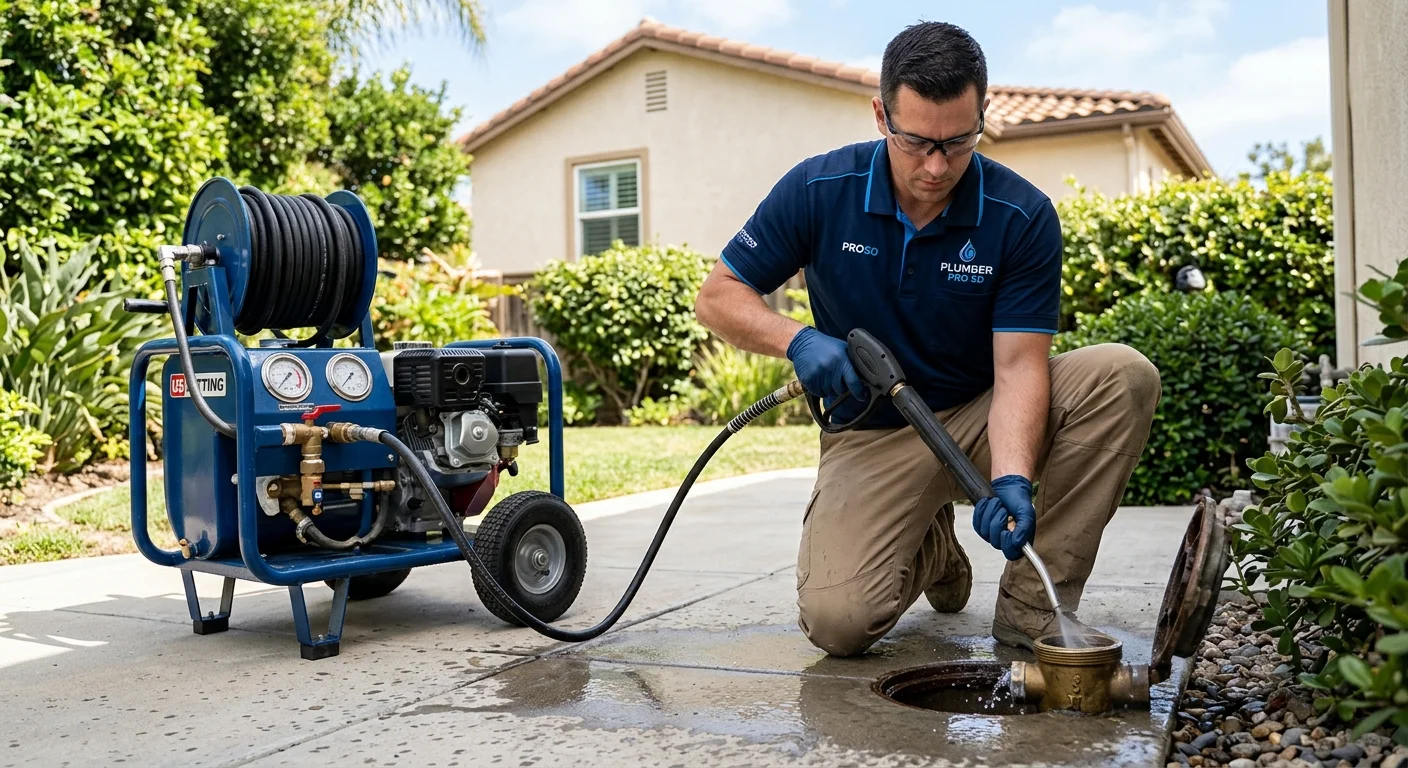
A sewer camera inspection answers what cleaning cannot. Cleaning can restore flow. It does not prove the pipe is sound. Hydro jetting may fit grease or light roots after the plumber sees that the pipe can take it. A cable may be enough for a first, concentrated obstruction. Neither one repairs a collapsed or offset lateral. That is sewer line work. The hydro jetting vs drain snaking comparison is the method choice after someone has looked inside the line. This page is the emergency pattern that gets you to that choice.
Permit rules for clearing a private lateral were not verified for this page. Ask Development Services or the building counter that covers the address. Even work under California’s contractor license threshold can still need a plumbing permit. The license exemption in Business and Professions Code section 7048 is $1,000 for casual, minor work as of January 1, 2026. It does not apply if the job is part of a larger operation, if contracts are split to stay under the cap, if someone advertises as a contractor, or if they hire another person to do the work. A main-line backup is not a hardware-store weekend.
How to request a drain and sewer referral
Tell us the pattern in one pass. Several drains. Which ones. Toilet, shower, floor drain, kitchen, laundry. Whether wastewater is inside, at a cleanout, or both. City or unincorporated county. Septic or sewer, if you know.
That routes the request to a C-36 plumber who does drains and laterals, not to a toilet-only call. California’s C-36 classification covers providing a means for safe water and the proper disposal of fluid waste, including the piping that carries that waste. Individual contractor capabilities still vary. You want someone who actually runs a cable, a jetter, and a camera, not only a closet auger.
We connect you with independent licensed plumbers. We do not clear the line, own the machines, or set the price. You contract with the plumber you hire. Every plumber in the network is licensed and insured.
Ask for a written quote before work starts. Drain cleaning prices are not a published official schedule, so we will not invent a range. The quote should say whether the plan is to clean, to camera, or to talk about repair if the pipe is damaged.
Check the license yourself at the CSLB license check. Search by license number, business name, or personnel name. The database is down Sundays 8 p.m. through Mondays 6 a.m. for maintenance. You want a current C-36.
Bring photos of the affected fixtures and, if you found it, the cleanout. A North Park bungalow with a clay lateral and a 1990s Carmel Valley tract house are different access problems. Say which one you have.
If the backup keeps returning after a cleaning, say so. Recurrence is a reason to look at the pipe, not a reason to buy another bottle of cleaner.
When to call us
Call when more than one drain is backing up, gurgling, or overflowing at the same time, or when a plunger on one toilet makes another fixture rise. The licensed plumbers we send handle shared-line clogs, laterals, and the choice between cleaning and repair. Call us at (858) 400-4417 and we’ll connect you with a licensed plumber.
Areas this guide covers
We connect homeowners with licensed plumbers in these San Diego County communities.
Keep reading
Need a Plumber in San Diego?
Licensed, insured plumbers, ready across San Diego County. The plumber quotes you before any work starts.
Call (858) 400-4417Call any time, day or night, anywhere in San Diego County