
Last updated: August 7, 2026
Sewer line repair in Lakeside, CA: diagnosing the backup
How a plumber diagnoses a sewer or drain backup in Lakeside, CA, from the cleanout check to root intrusion, septic versus sewer, and camera inspection.
The short answer
- One slow drain usually points to a fixture problem, while every drain backing up at once usually points to the main line or lateral.
- The cleanout is the fastest way to tell a fixture clog from a lateral blockage before anyone opens a wall or digs a trench.
- Mature trees near a buried lateral are a reason to rule root intrusion in or out early on that property.
- Some Lakeside properties run on septic instead of city sewer, and that changes who handles the problem and where the plumber's job ends.
- A camera inspection should produce a location, a cause, and a distance, not just a diagnosis of 'it's blocked somewhere.'
A sewer or drain problem in Lakeside almost always announces itself as either one slow drain or every drain at once, and that difference is the first real clue. Lakeside sits on the floor of the San Diego River valley in East County, inland enough to run hotter and drier than the coast, with larger unincorporated parcels and pockets where the sewer line never reached and homes still run on septic. Either of those can shape what’s actually wrong.
This is a diagnosis guide, not a repair estimate. The goal is to help you describe the problem accurately before a plumber shows up, and to know what a proper inspection should tell you once one does.
One slow drain or all of them
Start with the simplest test. Run water at the fixture that’s acting up and watch what happens elsewhere in the house.
If only that one drain is slow, and nothing else reacts, the problem is usually local: hair, grease, or a partial clog sitting in that fixture’s own branch line. That’s a drain cleaning job in most cases, and it rarely needs anything more invasive.
If flushing a toilet makes the shower gurgle, or running the washing machine backs up the kitchen sink, the fixtures are talking to each other through a shared line. That points toward the main drain or the sewer lateral, the pipe that carries wastewater from the house toward the street or the septic tank. A blockage there affects everything downstream of it at once.
Pay attention to timing too. A backup that only shows up after a load of laundry or a long shower suggests the line is nearly full and any added volume tips it over. A backup that happens no matter what you run suggests the line is already close to fully blocked.
None of this replaces a real inspection, but it gives the plumber a starting point instead of a blank slate. Describing “the toilet backs up when I run the washer” is far more useful than “my drains are slow,” and it can shorten the diagnostic visit.
What the cleanout tells you
The cleanout is a capped pipe fitting, usually near the foundation or somewhere along the yard toward the property line, that gives direct access to the main line without opening a wall or a floor.
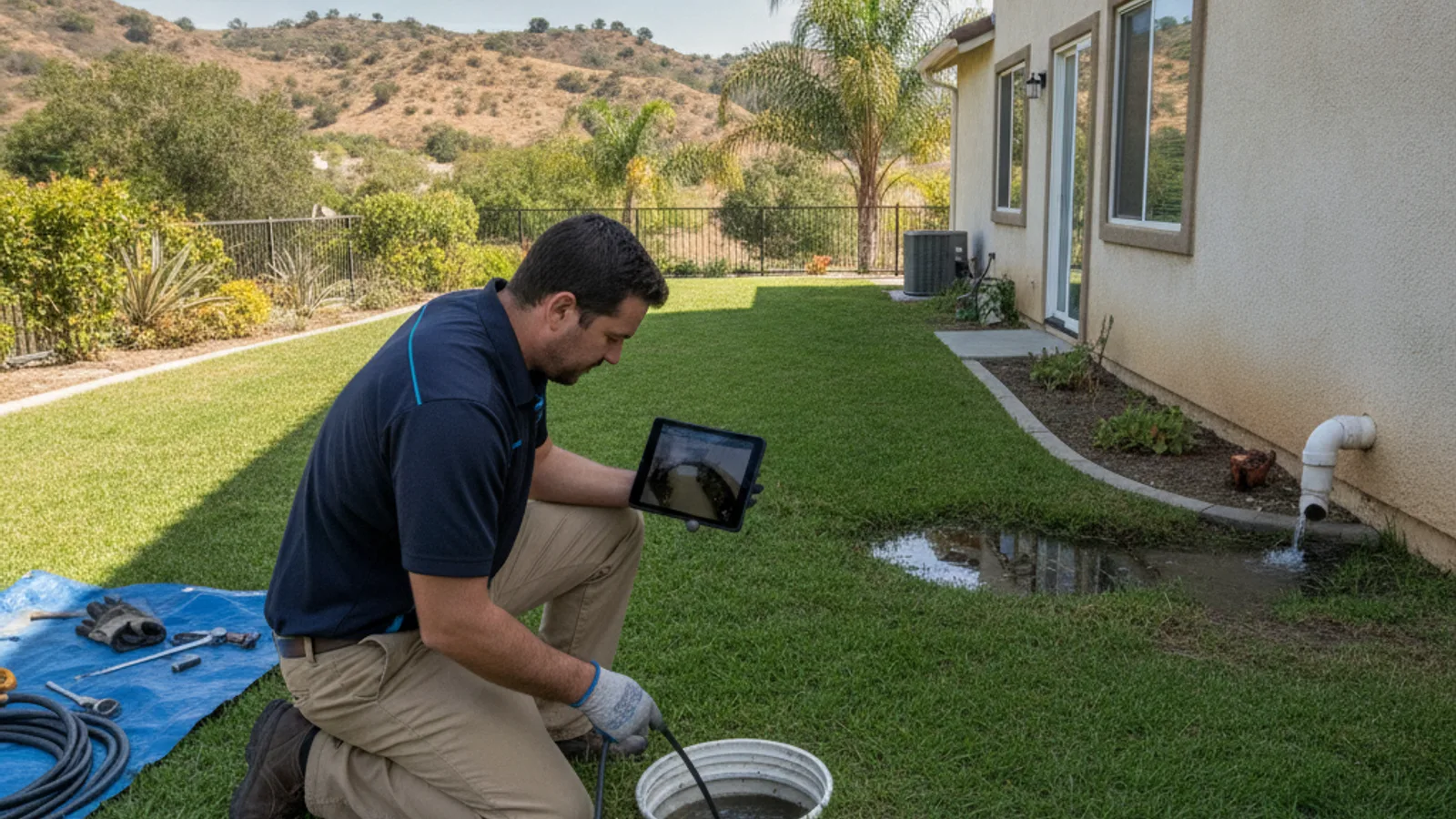
A plumber opens the cleanout and works from there. If a snake or camera run from the cleanout toward the house clears or finds nothing, the problem sits upstream in the house’s own branch lines. If the same run toward the street or the tank hits a wall of debris, roots, or standing water, the problem sits in the lateral itself.
This single step is what turns “somewhere in there” into “before or after this exact point,” and it’s the reason a real diagnostic visit starts at the cleanout rather than at the fixture that’s complaining.
If a property doesn’t have an accessible cleanout, or nobody can locate one, that’s worth mentioning up front. Older Lakeside properties sometimes predate the fitting being standard, and a plumber may need to identify another access point before doing anything else.
The three things that break a lateral out here
Lakeside’s terrain points toward a short list of realistic causes for a lateral problem, rather than a random guess. Which one actually applies to your property is something a camera confirms, not something to assume from the neighborhood.
Root intrusion. Mature trees near a buried line are a known cause of cracked joints and blocked pipe wherever they occur. If your property has established trees anywhere near the lateral’s likely path, root intrusion is worth ruling in or out with a camera rather than guessing either way.
Settling or offset joints. Valley-floor ground can shift or settle unevenly over the decades a lateral has been in the ground, and a pipe section that drops even slightly out of alignment creates a low spot where solids collect instead of flowing through. This is a structural issue, not a debris issue, and clearing it repeatedly won’t fix the underlying offset.
Pipe material and age. Clay and cast-iron lateral sections corrode or crack differently than modern PVC, and each responds differently to clearing versus repair. Most homeowners don’t know offhand what material their own lateral is. A plumber can identify it from the camera footage rather than anyone guessing from the house’s age.
A camera inspection is what separates these three from each other. Guessing which one applies without looking usually leads to paying for the wrong fix.
Sewer or septic, and why the answer changes the repair
Not every Lakeside address connects to the municipal sewer. The approved claims ledger doesn’t confirm which Lakeside addresses use private septic systems. Check your bill, then confirm the service type with the utility or wastewater agency for that address.
If you’re not sure which you have, check your water or utility bill for a sewer service line item. No such charge usually means septic. Our septic versus sewer guide covers how to confirm it and what to look for in the yard.
The distinction matters because it changes who’s responsible for what. On a sewer-connected property, homeowners are typically responsible for maintaining the lateral from the house to the point it connects with the public main. The exact boundary can vary by provider, so confirm it with the water or sewer agency named on your bill rather than assuming it matches a neighboring property.
On a septic property, a plumber still handles the house’s drains and the line running to the tank, including camera inspection of that section. What a plumber does not do is service, pump, or repair the septic tank or leach field itself. If the backup traces to the tank being full or the leach field failing, that’s a separate trade, and mixing the two up wastes a visit.
If every fixture in the house is backing up and you’re on septic, check the tank access lid for standing liquid at or near the surface before assuming the problem is in the pipe.
What a camera inspection should produce
A camera inspection is only useful if it produces specific answers, not a vague verdict.
Ask for the distance from the cleanout to the problem, the pipe material observed, and the specific cause: a root mass, a crack, a low spot, or a joint that’s separated. “It’s blocked” without those details doesn’t give you or the plumber enough to choose a repair method.
| What you’re noticing | What it usually narrows to |
|---|---|
| One drain slow, others unaffected | Fixture-side clog in that branch line |
| Every drain backing up together | Main line or lateral blockage |
| Gurgling in other fixtures during use | Shared line reacting to a partial blockage |
| Backup worse after heavy rain or irrigation | Possible offset or crack allowing infiltration |
| Sewage odor near mature trees in the yard | Root intrusion or a break under the landscaping |
| Backup on a known septic property | Tank or leach field issue, outside a plumber’s scope |
Once the location and cause are confirmed, a plumber can talk through whether the fix is a targeted repair, a longer section replacement, or hydro jetting to clear the line before deciding anything more invasive is needed. For lateral-specific work, see our sewer line services and sewer camera inspection pages, and check the Lakeside plumbing service page for what’s available in your area. Our guide on tree roots in sewer lines and signs of a sewer line problem go deeper on both of these causes.
Questions about Lakeside sewer lines
How do I know if my Lakeside drain problem is the lateral or a fixture?
Run water at the affected fixture and watch whether other fixtures react. One slow drain with nothing else affected usually means a local clog. Multiple fixtures gurgling or backing up together usually means the shared line is the problem.
What is the cleanout and why does a plumber check it first?
The cleanout is a capped access point to the main drain line, often near the foundation or the property line. Working from it tells a plumber whether a blockage sits before or after that point instead of guessing.
Can tree roots obstruct a Lakeside sewer lateral?
Roots can obstruct a sewer lateral. A camera inspection confirms whether roots, and not something else, are the actual cause on your property.
How do I know if my Lakeside home is on septic or sewer?
Check your water or utility bill for a sewer service charge. If there isn’t one, don’t assume the property is on septic. Confirm the service type with the utility or wastewater agency for that address.
What should a sewer camera inspection tell me?
Ask for the distance from the cleanout, the pipe material, and the specific cause, such as roots, a crack, or a low spot. A vague “it’s blocked” result doesn’t give you enough to choose a repair.
When to call us
A single slow drain might clear with basic maintenance, but repeat backups, sewage odor in the yard, or a blockage that keeps returning need a real diagnosis before anyone spends money on a fix. Have your address, which fixtures are affected, and whether you know your property is on sewer or septic ready when you call. Call (858) 400-4417 and we’ll connect you with a licensed and insured local plumber.
Areas this guide covers
We connect homeowners with licensed plumbers in these San Diego County communities.
Keep reading
Need a Plumber in San Diego?
Licensed, insured plumbers, ready across San Diego County. The plumber quotes you before any work starts.
Call (858) 400-4417Call any time, day or night, anywhere in San Diego County