
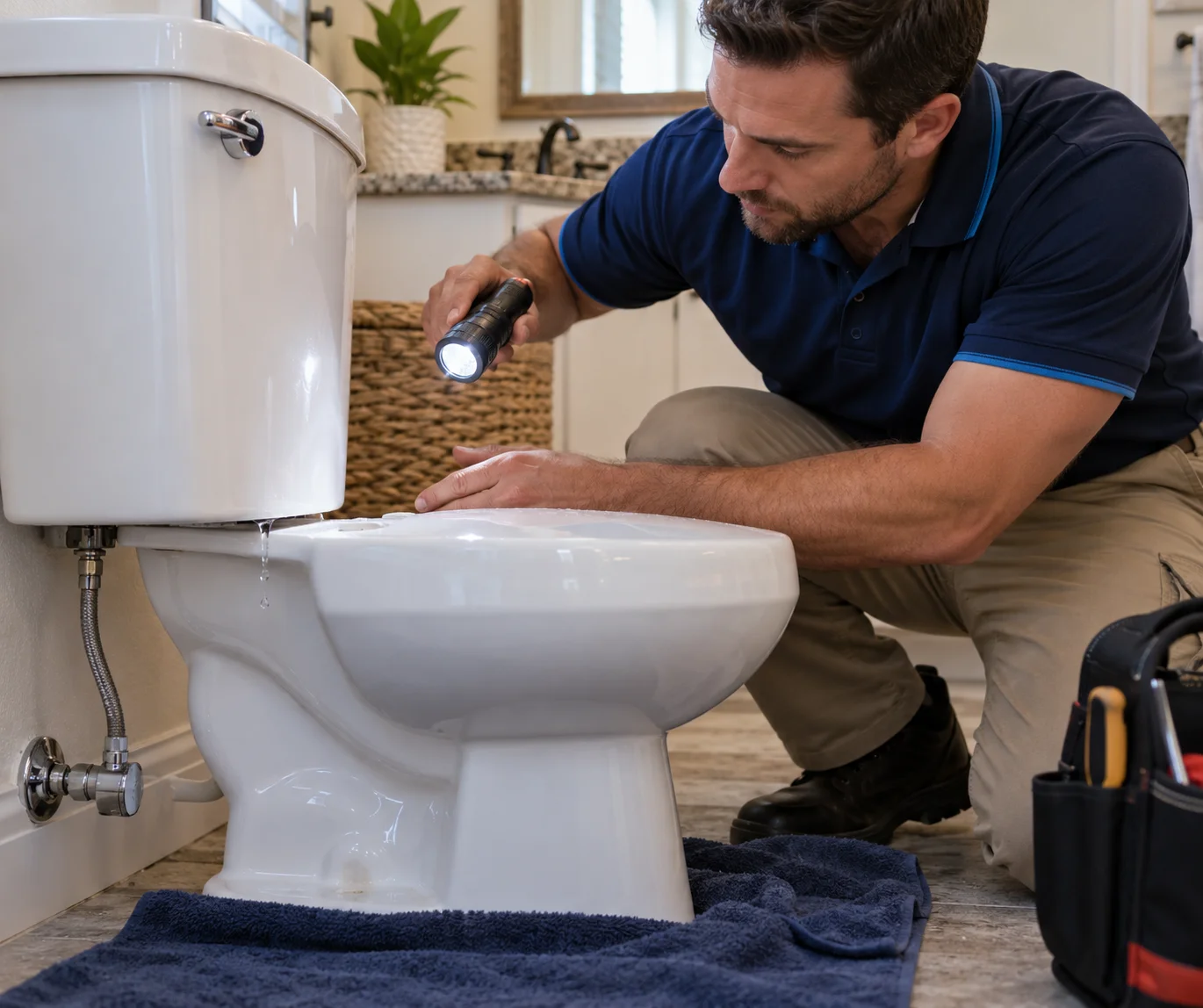
Water leaking between the toilet tank and bowl
Water leaking between the toilet tank and bowl? Learn what a plumber may inspect and request a licensed toilet repair referral in San Diego.
Water appearing between the toilet tank and bowl calls for a focused inspection. A plumber for a leaking toilet can check that connection without assuming one specific part has failed.
When water appears only during or after a flush
Start by noting exactly when the water appears. A drip that begins during a flush gives the contractor a useful starting point. Water found later may have traveled from somewhere else.
Dry the visible porcelain and nearby floor before observing the toilet. Then note where the first moisture becomes visible. Don’t keep flushing if each test releases more water into the room. Instead, record what you saw and request toilet repair.
Helpful details include:
- Whether the leak starts during the flush or afterward
- Whether water appears beneath the tank’s center or near one side
- Whether the tank moves when the toilet is used
- Whether moisture also appears behind the toilet
- Whether the floor becomes wet around the base
- Whether the problem follows every flush or only some flushes
These observations don’t prove which component is responsible. They help the plumber separate a tank-to-bowl connection problem from another leak nearby.
Also check whether water is collecting on the tank’s outside surface. Tell the contractor if the entire tank feels damp, rather than one connection point. The source still needs an inspection, but that distinction can prevent a false diagnosis.
This problem appears in bathrooms throughout San Diego County. The room layout can affect access, especially in compact baths or toilets placed close to a wall. Homes in La Mesa and nearby East County communities may need local service coverage. Our guide to finding a plumber in La Mesa explains that referral option.
How the tank gasket and mounting points differ
The tank and bowl meet at more than one point. A contractor may inspect the central opening between them and the mounting points that hold the pieces together. Those locations serve different purposes, even though escaping water can appear in the same general area.
People often search for “toilet tank gasket leaking” after seeing water beneath the tank. That phrase describes one possibility, not a confirmed diagnosis. Moisture could emerge near the center, near a mounting point, or along the porcelain before dripping downward.
The mounting area also deserves a careful look. A plumber may check for visible movement, uneven contact, damaged hardware, worn sealing material, or signs that water followed an indirect path. The porcelain may also be inspected for visible damage. None of those conditions should be assumed from the drip alone.
Avoid choosing replacement parts only from the location of water on the floor. Water can run along a smooth surface before it drops. A wet spot below one side doesn’t establish that the part directly above it caused the leak.
The contractor you hire can explain what was found after the tank area is inspected. If a part needs replacement, ask which part failed and why the proposed repair addresses the observed leak. For broader fixture work around sinks, faucets, toilets, and nearby connections, see our bathroom and kitchen plumbing referral service.
Repair pricing can’t be confirmed from the symptom alone. The approved government sources don’t provide a standard price for this repair. Ask the independent contractor for a job-specific estimate after the inspection.
Why a base leak or supply leak needs another diagnosis
Water under a toilet doesn’t always come from the tank-to-bowl connection. The first visible puddle may be misleading, particularly when water travels down the fixture or along the floor.
A base leak appears around the point where the toilet meets the floor. It needs a different diagnosis because the bowl-to-floor area isn’t the same connection as the tank-to-bowl area. If moisture first appears at floor level, read our guide to a toilet leaking at the base.
A supply connection is another separate area. The supply line runs to the toilet and connects near the tank. Moisture behind or beside the fixture may come from that route rather than between the tank and bowl. Our article about a leaking toilet supply line covers that symptom pattern.
An internal water-loss problem is different again. If water moves inside the bowl without appearing outside the fixture, the contractor may inspect internal components. That isn’t the same complaint as water escaping onto the exterior after a flush.
When requesting a referral, describe the first place you can actually see water. Don’t label the cause unless a contractor has already confirmed it. “Water appears below the tank after flushing” is more useful than declaring that a particular gasket or bolt has failed.
A plumber may need to inspect several nearby points before identifying the source. That’s normal diagnostic work, not evidence that every nearby component needs replacement. Ask the contractor to show you the observed source and explain the proposed scope before you approve the job.
What the contractor you’re matched with may inspect
The independent contractor may begin by reviewing your description and observing the connection. The exact inspection depends on access, the toilet’s condition, and what can be seen at the property.
The plumber may inspect:
- Where moisture first appears during or after a flush
- The connection between the tank and bowl
- The mounting points and visible hardware
- Any movement between the tank and bowl
- The exterior porcelain for visible damage
- The supply connection and nearby surfaces
- The base and surrounding floor for separate moisture
- Internal tank components when the symptoms point elsewhere
This list doesn’t promise a particular test or repair. Individual contractor capabilities and inspection methods vary. The findings at your toilet should determine the recommendation.
California’s C-36 classification covers plumbing work involving safe water supply, fluid-waste disposal, piping, and repairs within that scope. It doesn’t establish that every contractor offers every specific service. You can check a contractor by license number, business name, or personnel name through the CSLB license lookup. The database provides license status, classifications, bond information, complaint history, expiration details, and workers’ compensation information. It’s unavailable during scheduled maintenance from Sunday at 8 p.m. through Monday at 6 a.m.
Every plumber in our network is licensed and insured. Plumbing Pro San Diego remains a referral service. The homeowner hires and pays the independent contractor directly, and that contractor performs the inspection and repair.
How to request a toilet repair referral
Tell us you need a plumber for a leaking toilet. Mention that water appears between the tank and bowl, then describe when it happens. “During the flush,” “immediately afterward,” or “the timing isn’t clear” are all useful descriptions.
Include the property’s city or community within San Diego County. We serve every city in the county, including coastal, central, inland, East County, and South Bay communities. Your location helps us match you with a contractor serving that part of the county.
Share any access details that may affect the visit. For example, mention a toilet placed tightly between a vanity and wall. Also say whether it’s the property’s only toilet and whether water is reaching nearby flooring or cabinetry. These details communicate the situation without guessing at the failed part.
Photos can help show where the moisture becomes visible. A short description of what happens during a flush can also help. The contractor still needs to make the diagnosis.
Don’t combine unrelated symptoms into one assumed cause. If the toilet also clogs, runs internally, rocks, or leaks at the supply line, list each symptom separately. A clogged toilet involves a different question than an external tank leak. No verified government figure sets one standard charge for either service, so pricing must come from the contractor after reviewing the actual scope.
Plumbing Pro San Diego doesn’t perform the repair, set the price, or provide a work warranty. We connect you with an independent licensed contractor. You’ll review the diagnosis, estimate, terms, and any contractor warranty directly with that business.
When to call us
Call when water appears between the tank and bowl, the source remains unclear, or the fixture needs inspection by a licensed plumber. Call us at (858) 400-4417 and we’ll connect you with a licensed plumber.
Areas this guide covers
We connect homeowners with licensed plumbers in these San Diego County communities.
Keep reading
Need a Plumber in San Diego?
Licensed, insured plumbers, ready across San Diego County. The plumber quotes you before any work starts.
Call (858) 400-4417Call any time, day or night, anywhere in San Diego County