
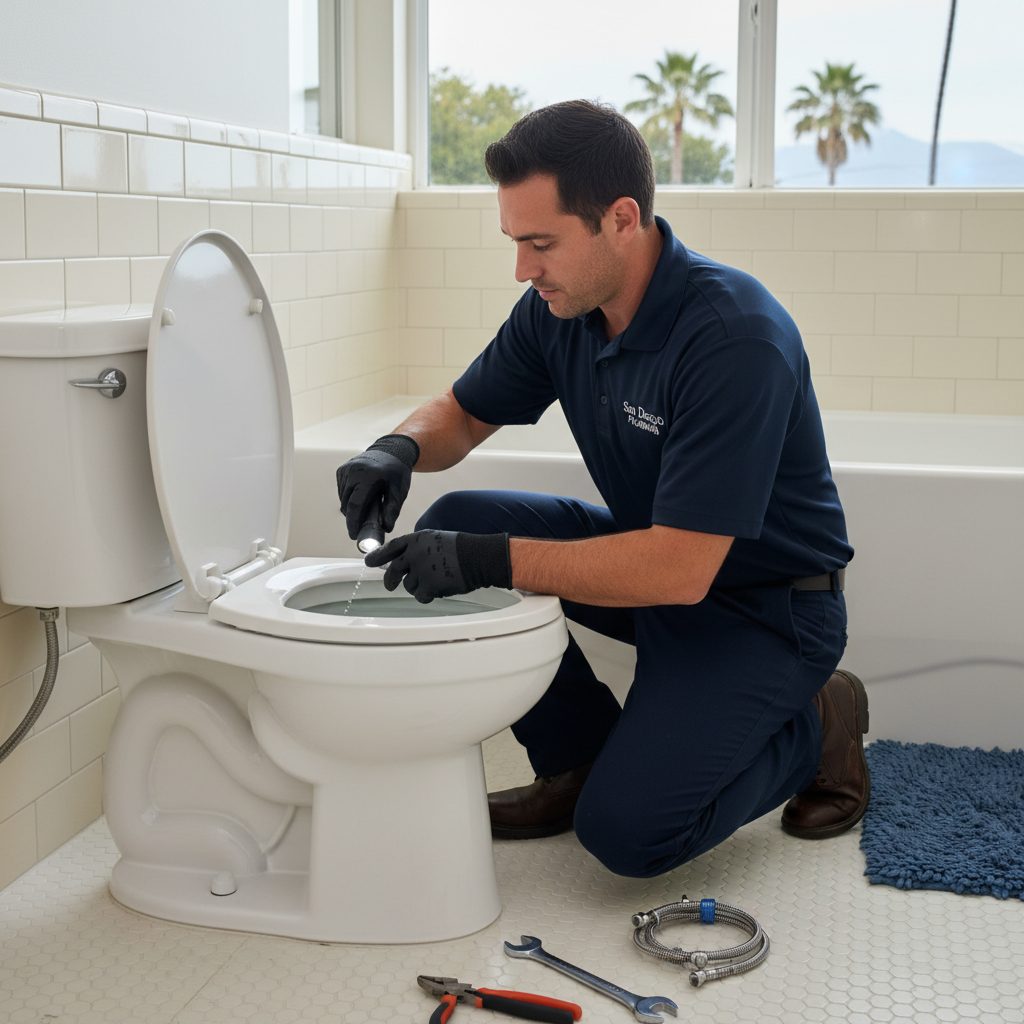
California's water-conserving fixture law in San Diego
California's water-conserving fixture law still applies to older San Diego homes. What's noncompliant, who has to fix it, and what changed in San Diego in 2022.
The short answer
- California's water-conserving plumbing fixture law (Civil Code 1101.1 to 1101.9) requires homes built on or before January 1, 1994 to replace old toilets, showerheads, faucets, and urinals with low-flow models.
- The state deadline for single-family homes was January 1, 2017. That date already passed, but the law didn't go away. It shows up now whenever you pull a permit or sell the house.
- A noncompliant fixture is a toilet over 1.6 gallons per flush, a showerhead over 2.5 gallons per minute, or a faucet over 2.2 gallons per minute.
- The City of San Diego stopped requiring a Water Conservation Certificate at resale in February 2022. Sellers still have to disclose noncompliant fixtures to buyers; that part of the law is unchanged.
- Swapping fixtures runs a few hundred dollars in most homes. Call (858) 400-4417 if you want a plumber to check what's still noncompliant before you list or remodel.
California’s water-conserving plumbing fixture law already applies to your San Diego home if it was built on or before January 1, 1994, whether or not you’ve ever heard of it. The rule sits in Civil Code sections 1101.1 through 1101.9, and most people still know it by its old bill number, SB 407. It requires older, water-hungry toilets, showerheads, faucets, and urinals to be swapped for low-flow models. The compliance deadline for single-family homes was January 1, 2017. That date has come and gone, but the law hasn’t. It resurfaces the moment you pull a permit for anything else in the house, or the moment you put the house on the market.
What counts as a noncompliant fixture under the water-conserving law
The law defines four fixture types and the exact flow rate that makes each one noncompliant.
| Fixture | Noncompliant if it exceeds | What replaces it |
|---|---|---|
| Toilet | 1.6 gallons per flush | 1.28 GPF or lower, WaterSense labeled |
| Showerhead | 2.5 gallons per minute | 2.0 GPM or lower |
| Interior faucet (kitchen or bath) | 2.2 gallons per minute | 1.2 to 1.8 GPM depending on use |
| Urinal | 1 gallon per flush | 0.5 to 1 GPF, high-efficiency |
There’s a fifth category people rarely expect: a reverse osmosis drinking water system without an automatic shut-off valve also counts as noncompliant under the same statute, separate from anything to do with flow rate. If your home has an older RO unit under the kitchen sink that was never upgraded, it’s worth having a plumber check that valve while they’re checking everything else.
Which San Diego homes this applies to
The trigger is the build date, not the neighborhood or the price point. Any residential property built and occupied on or before January 1, 1994 falls under the law. That covers a large share of San Diego County’s housing stock, including the mid-century tract homes across El Cajon and La Mesa, the older bungalows in North Park and Normal Heights, and plenty of coastal properties from Ocean Beach to Encinitas that were built decades before low-flow fixtures were standard. If your home was built after 1994, it was already required to have compliant fixtures from day one, so this specific retrofit law doesn’t apply to you.
Homes that have been fully remodeled since 1994, with every bathroom and kitchen redone, are usually fine, since compliant fixtures were required on those permits already. The homes worth double-checking are the ones with a mix: a remodeled kitchen from ten years ago sitting next to a guest bathroom nobody’s touched since the Reagan administration.
The deadlines already passed, but the law didn’t disappear
Here’s where a lot of homeowners get the timeline wrong. The dates that actually matter are behind us:
Single-family homes had to be fully compliant by January 1, 2017, period, whether or not any construction was happening. Multifamily and commercial properties had until January 1, 2019. And starting January 1, 2014, any permitted alteration or improvement to a single-family home built on or before 1994 has required all noncompliant fixtures on the property, not only the ones in the remodeled space, to be replaced as a condition of getting the City to sign off on final permit approval.
That last part is the one that catches people today, years after the original deadlines. Pull a permit for a kitchen remodel, an addition, or even a water heater swap that needs a permit, and the City’s inspector can hold up your final sign-off over a noncompliant toilet in a bathroom you had no intention of touching.
Why this still comes up years later
Two situations bring this law back into the picture on a property that’s owned by someone who’s never heard of it. The first is any permitted work. If you’re remodeling a bathroom in La Mesa or adding a room in El Cajon, your contractor’s permit application puts the whole house’s fixture compliance on the table, not just the room in the scope of work. The second is selling the house. California requires sellers to disclose noncompliant fixtures to buyers at the time of transfer, and a sharp buyer’s agent or inspector will flag a house full of original 1980s toilets during due diligence, which can turn into a repair request or a price negotiation late in escrow.
Neither situation is really about penalties. Nobody’s showing up to fine you for an old toilet sitting untouched in a house you’re not selling or remodeling. The exposure is practical: a stalled permit, or a buyer who wants a credit at the closing table for something you could have fixed for a few hundred dollars months earlier.
What changed in San Diego in 2022, and what didn’t
For years, the City of San Diego required sellers to file a separate Water Conservation Certificate confirming fixture compliance before a property could change hands. The City eliminated that certificate filing requirement on February 28, 2022. If you sold a home in San Diego before that date, you probably remember the paperwork. If you’re selling one now, that specific form is gone.
What that change didn’t touch is the underlying state law. The Civil Code disclosure requirement is still active: sellers still have to tell buyers about any noncompliant fixtures at the time of transfer, almost always through the Real Estate Transfer Disclosure Statement that’s part of a standard California home sale. Dropping the City’s certificate made the paperwork lighter. It didn’t make the fixtures themselves legal to leave in place, and it didn’t remove the disclosure obligation.
What it costs to get compliant
Swapping out noncompliant fixtures is one of the cheaper plumbing projects a San Diego homeowner runs into, especially compared to what a stalled permit or a buyer credit at closing can cost. A standard toilet installation in San Diego runs $325 to $725 for labor plus $150 to $900 for the toilet itself, depending on the model. Faucet installation runs $150 to $400 per fixture for most kitchen and bathroom swaps. A showerhead swap is the cheapest line item of the group and often gets bundled into the same visit as everything else, since it’s a quick fix once a plumber is already on site.
If you’re already pulling a permit for a bathroom remodel, the compliance swap for the rest of the house is worth handling in the same visit rather than waiting for the inspector to flag it separately. Our toilet repair and fixture installation services cover exactly this kind of whole-house compliance pass, and if your home still has an older reverse osmosis unit without a shut-off valve, our water filtration service covers that piece too.
Selling or remodeling an older San Diego home
If you’re getting ready to list a home in La Mesa, El Cajon, or anywhere else in the county with a housing stock that predates 1994, a quick fixture walkthrough before you list can save you a negotiation later. The same goes before you pull a permit for any remodel. Plumbing Pro San Diego can check every toilet, showerhead, and faucet on the property and swap what’s noncompliant in a single visit. Call (858) 400-4417 for a straightforward quote, or see our service area in La Mesa and El Cajon for local scheduling.
This article explains a California statute in plain terms and isn’t legal advice. For questions specific to your sale or your permit, talk to your real estate agent, your contractor, or an attorney.
Areas this guide covers
We connect homeowners with licensed plumbers in these San Diego County communities.
Keep reading
Need a Plumber in San Diego?
Licensed, insured plumbers, ready across San Diego County. The plumber quotes you before any work starts.
Call (858) 400-4417Call any time, day or night, anywhere in San Diego County